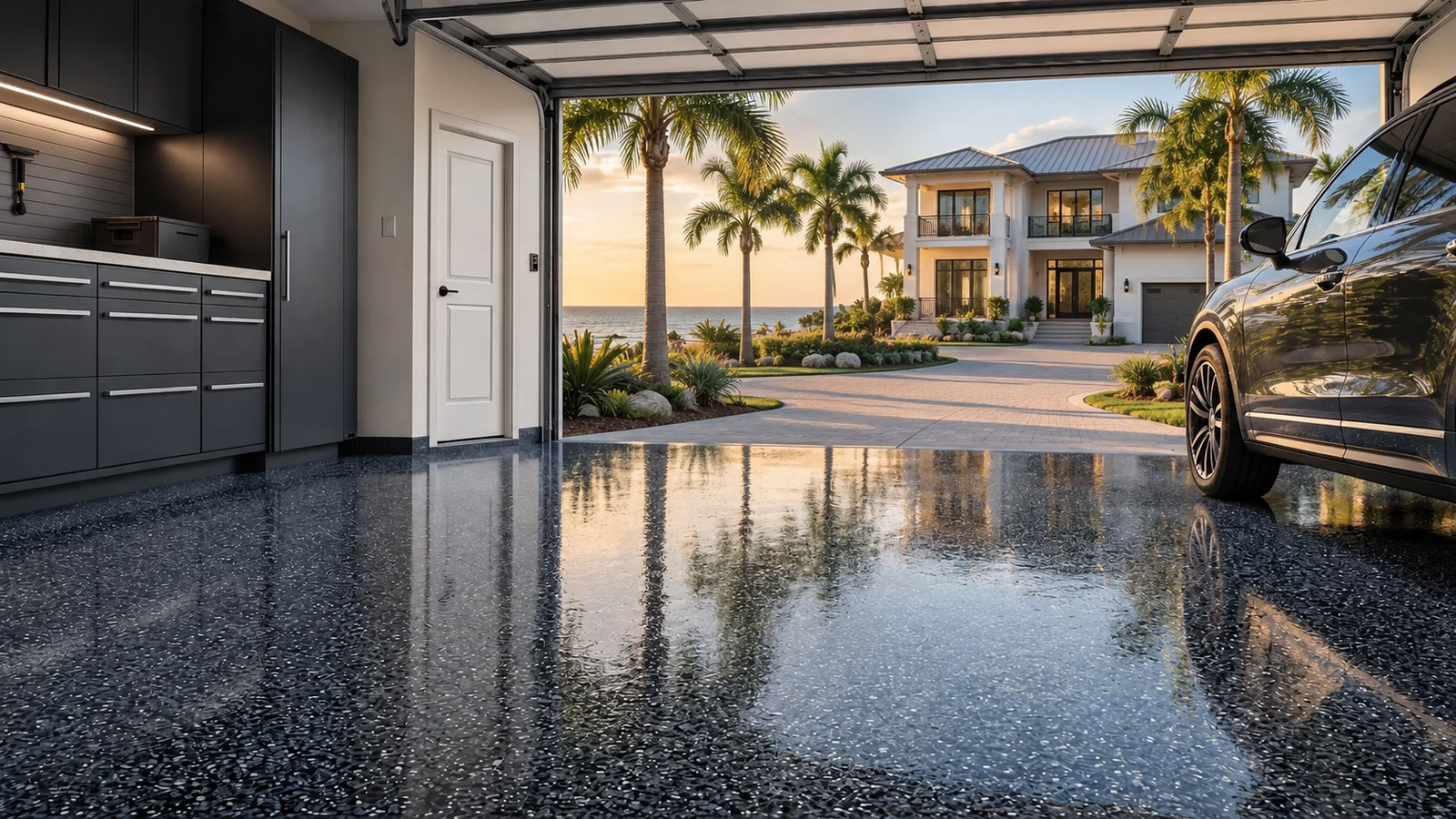
Garage Floor Coating in Sunrise, FL
Explore garage and commercial concrete coating options for Sunrise properties in western Broward.
Floor Coating Considerations in Sunrise, FL
Sunrise has a distinctive public drainage context rather than one generic South Florida water story. Sunrise identifies separate tertiary catch-basin and swale, secondary lake/canal and SFWMD primary-canal systems. These city-level or regional responsibilities can help an owner ask informed questions, but do not establish the condition of concrete within a private garage. Existing floor paint, patches, vapor evidence and the actual driveway threshold need inspection before a resin system is selected.
City guidance says roadside swales must not be altered without checking with Engineering. In addition, the city's program warns that storm drains send untreated rainwater to canals and lakes. Those local details matter when water moves along public streets or canals, but the decisive property question is whether rain repeatedly crosses the garage door or is simply tracked inside by vehicles. A new coating cannot change the slope of an exterior driveway or repair a canal.
For a Sunrise garage, compare old-coating removal, mechanical profiling, repairs and moving joints rather than assume every house shares the same concrete condition. Sun through an open door, hot tires, finish texture, cleaning habits and the time before returning vehicles also shape an appropriate epoxy or polyaspartic assembly. Get a complete material-and-cure specification and keep outside drainage correction separate from decorative flooring.
Local Market Insight
Sunrise identifies separate tertiary catch-basin and swale, secondary lake/canal and SFWMD primary-canal systems. City guidance says roadside swales must not be altered without checking with Engineering. These are public infrastructure observations, not a garage slab test; the homeowner must separately inspect old finishes, actual water entry and concrete condition.
What Affects the Cost of Garage Floor Coating in Sunrise?
The best Sunrise estimate distinguishes property-level runoff from municipal stormwater systems. Sunrise identifies separate tertiary catch-basin and swale, secondary lake/canal and SFWMD primary-canal systems. That background does not establish what surface preparation or moisture treatment a particular floor needs.
These city-level or regional responsibilities can help an owner ask informed questions, but do not establish the condition of concrete within a private garage. This is useful when defining the scope of a Sunrise garage estimate, not a basis for a citywide price premium. The published $6–$12 per-square-foot and $3,000–$5,500 typical two-car ranges are planning references only. Ask the bidder to itemize removal, grinding, any repairs and the full coating system before treating a quote as comparable.
A typical two-car garage generally ranges from $3,000-$5,500. Final cost varies with square footage, concrete condition, crack repair, moisture mitigation, prep intensity, coating system, and decorative finish.
- Local stormwater responsibilities: Sunrise identifies separate tertiary catch-basin and swale, secondary lake/canal and SFWMD primary-canal systems. Public-system work is different from private drainage and does not measure slab moisture or old coating adhesion.
- Other local drainage details: City guidance says roadside swales must not be altered without checking with Engineering. This recorded issue should guide sensible threshold questions rather than a universal moisture-barrier recommendation.
- Neighborhood-specific infrastructure: The city's program warns that storm drains send untreated rainwater to canals and lakes. Public drainage and address-level concrete conditions must remain separate when preparing a quote.
- Prior finishes and repairs: Oil stains, old paint, patches and cracks should be identified before grinding and any coating. The manufacturer's concrete profile requirements apply.
- Joints and garage access: Movement joints, steps, cabinets, side edges and door aprons can affect preparation labor independently of floor area.
- UV and return-to-use: Specify primer, base and topcoat, UV performance at a sunlit entrance, texture, traction and cure conditions before parking.
Call for a clear, project-specific estimate — or request one online.
Sunrise Public Drainage and a Homeowner's Garage Door
Sunrise identifies separate tertiary catch-basin and swale, secondary lake/canal and SFWMD primary-canal systems. This information comes from the relevant public infrastructure setting and provides meaningful local context. But it is not evidence that a particular floor has excess vapor emissions, nor is it a property-specific flood forecast. It should lead to more careful observation instead of a one-product-fits-every-garage sales pitch.
City guidance says roadside swales must not be altered without checking with Engineering. The important garage-scale distinctions are whether pavement slopes into the garage, whether rainwater collects against the door and whether wet spots are simply tracked inside on tires. Neither a city improvement project nor proximity to a canal answers those questions without a site visit.
The city's program warns that storm drains send untreated rainwater to canals and lakes. An individual owner may face a private drain or driveway issue even when a municipal network is well maintained, or have perfectly acceptable threshold conditions in an area with broader planning concerns. Public flood-management records cannot determine old paint adhesion or what surface profile a new system needs.
City guidance says roadside swales must not be altered without checking with Engineering. For a Sunrise floor project, this distinction requires inspecting the actual garage doorway after rainfall rather than assuming public drainage predicts indoor conditions. Water carried in by tires, flow crossing a driveway lip and concrete that remains damp have different causes. Document them before any moisture-related product is proposed, and keep exterior drainage corrections separate from the finish.
Concrete Preparation and Garage Use in Sunrise
Concrete floors in Sunrise garages can vary according to construction generation, prior repairs, remodeling and use. An apparently clean slab may contain penetrating sealer; another may have weak paint or oil contamination that needs removal before a resin assembly can bond. Visual appearance and the neighborhood's housing value do not establish substrate suitability.
Those local details matter when water moves along public streets or canals, but the decisive property question is whether rain repeatedly crosses the garage door or is simply tracked inside by vehicles. The corresponding garage inspection should identify old paint and sealers, contaminated areas, patch compounds and the profile of sound concrete. Stable repairs and movement joints must be handled differently. Ask which areas near steps, shelving and edges are included in preparation and what happens if grinding exposes a weak prior finish.
For a Sunrise garage, compare old-coating removal, mechanical profiling, repairs and moving joints rather than assume every house shares the same concrete condition. For a Sunrise floor project, this distinction requires inspecting the actual garage doorway after rainfall rather than assuming public drainage predicts indoor conditions. Water carried in by tires, flow crossing a driveway lip and concrete that remains damp have different causes. Document them before any moisture-related product is proposed, and keep exterior drainage corrections separate from the finish.
Get a complete material-and-cure specification and keep outside drainage correction separate from decorative flooring. For a Sunrise floor project, this distinction requires inspecting the actual garage doorway after rainfall rather than assuming public drainage predicts indoor conditions. Water carried in by tires, flow crossing a driveway lip and concrete that remains damp have different causes. Document them before any moisture-related product is proposed, and keep exterior drainage corrections separate from the finish.
Frequently Asked Questions
Does Sunrise's public stormwater program tell me whether my garage slab is damp?
No. Sunrise identifies separate tertiary catch-basin and swale, secondary lake/canal and SFWMD primary-canal systems. That provides drainage context, not a reading from an individual slab or evidence about previous floor paint.
What other local water concern should I know?
City guidance says roadside swales must not be altered without checking with Engineering. It may inform driveway inspection, but only actual water entering the garage warrants a separate drainage correction.
Is the entire Sunrise area affected the same way?
No. The city's program warns that storm drains send untreated rainwater to canals and lakes. Individual properties and garage thresholds vary; do not extrapolate from citywide projects.
Can epoxy cover old paint or hide moving cracks permanently?
The existing finish must be evaluated and unsuitable coatings removed; stable repairs and control joints that move require different treatment.
How should I compare Sunrise garage-floor bids?
Compare removal, grinding, repairs, edge details, specified primer and topcoat, traction, sun exposure and time before vehicles can return.
Sunrise Neighborhoods & Local Context
Phone Quote Line
Talk through your floor, coating options, and a realistic estimate range.
(954) 800-4562Typical Project Cost
$3,000-$5,500
Typical range for a two-car garage. Final pricing depends on floor size, concrete condition, prep work, coating type, and finish options.
Helpful Guides